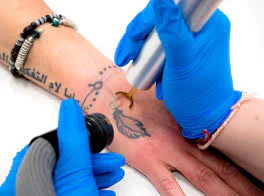
Laser tattoo removal is a course of treatments spread over many months, and what you do between appointments affects the outcome as much as what happens during them. Ink is cleared by your own body, and the process depends on you healing well each time.
This covers what happens immediately afterwards, how to look after the area, why sessions are spaced the way they are, and what changes if you are fading a tattoo for a cover-up rather than removing it.
What happens immediately after a session?
The treated area usually turns white for a few minutes. This is called frosting and it is expected, caused by gas released as the ink particles shatter. It settles quickly.
Underneath, the skin behaves like a graze. Redness, warmth, swelling and tenderness are normal for the first day or two, and the area may feel like mild sunburn. Some pinpoint bleeding can occur.
A dressing is applied before you leave, and the clinic will tell you how long to keep it on.
Blistering is normal, and not a mistake
Blisters can appear within the first day, sometimes large ones, and they alarm people who were not warned. They are part of the healing response rather than a sign something went wrong.
Leave them alone. Do not pop or drain them. If one bursts on its own, keep the area clean and covered and let it heal, and tell the clinic at your next appointment.
Looking after the area
- Keep the area clean, washing gently with mild soap and water and patting dry rather than rubbing
- Apply the ointment the clinic recommends and keep the area covered while it is healing
- Leave scabs and blisters to resolve on their own, however tempting
- Avoid soaking the area, so no baths, swimming pools, saunas or steam rooms until the skin has closed
- Skip the gym for the first couple of days, since sweat and friction both work against healing
- Keep it out of the sun entirely while healing, then protect it with a high factor daily
That last point is the one people underestimate. Tanned skin changes how the next session can be delivered, and treating over a tan is not appropriate, so sun exposure between appointments can delay your whole course.
Why are sessions spaced so far apart?
Because the laser does not remove the ink. It breaks the pigment into fragments small enough for your immune system to carry away, and that clearance happens gradually over the weeks afterwards.
Treating again before the body has finished clearing the previous round achieves little and adds unnecessary trauma to the skin. The interval exists so the work already done can complete.
Some people find that frustrating and ask to be treated more frequently. It does not speed anything up, and it increases the risk of side effects.
What affects how quickly ink clears
Your general health, your circulation, whether you smoke, how much you move, and where the tattoo sits on your body. Areas with better blood supply tend to clear faster than extremities such as fingers, feet and ankles.
Staying well hydrated and reasonably active supports the process, which is about as far as the honest advice goes. There is no supplement that speeds up ink clearance.
Fading for a cover-up is a different objective
Not everyone is aiming for complete removal, and this changes the plan considerably.
If your tattooist needs the existing ink lightened enough to work over, the target is a reduction in density rather than a clear canvas. That takes far fewer sessions than complete removal, because the last stages of clearing ink are the slowest.
Bring the design you are considering, or your tattooist’s guidance on how much fading they need, to the consultation. The plan is built around that target, and being clear about it from the start saves both time and money.
Allow the skin to recover fully before it is tattooed over, and take your tattooist’s advice on timing.
What to expect over a course
Progress is uneven, and it is worth knowing that in advance. Black and dark inks generally begin to fade first. Colours behave differently from one another, greens and blues typically being the most stubborn, which is why more than one wavelength is often needed.
Some sessions produce visible change and others appear to do very little. That is normal, and photographs taken at the start are far more reliable than memory when you are looking at the same tattoo every day.
Older tattoos have usually faded somewhat already. Amateur tattoos often clear more readily than professional work, since the ink tends to be less densely packed.
When to contact the clinic
Some things warrant a call rather than waiting for the next appointment: increasing rather than decreasing pain, spreading redness or heat around the area, yellow or green discharge, a fever, or any sign the area is not healing over as expected.
None of these is common, and all are more easily dealt with early.
Things people ask about scarring
Scarring is uncommon with modern lasers when the area is looked after properly, and most of what people take for scarring afterwards is temporary textural change that settles.
Where it does occur, the two biggest contributing factors are within your control: interfering with blisters and scabs, and sun exposure during healing. Any pre-existing scarring from the original tattoo will still be there once the ink has gone, since the laser treats pigment rather than texture.
Before the next session
Turn up with the area clean, unshaved if the clinic has asked for that, free of moisturiser or makeup, and out of the sun for the preceding weeks. Mention anything that has changed since your last appointment, including new medication.
If the area has not fully healed, say so rather than pressing on. A postponed session costs a few weeks; a session on skin that is not ready can cost considerably more than that.
Getting the plan right
Aftercare is straightforward, and most of it comes down to leaving the area alone and staying out of the sun. The plan around it, how sessions are spaced, which wavelengths suit your ink and skin, and whether you are removing or fading, is what a consultation establishes.
Pulse Light Clinic is CQC-registered and doctor-and-nurse-led, and has been treating patients in London since 2001. You can read more about laser tattoo removal here.
Book a consultation to have your tattoo assessed and a plan agreed.