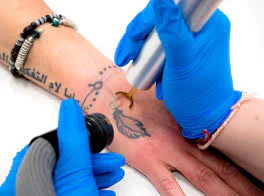
Both remove tissue from the skin surface. Both prompt collagen production. Both are described as ablative resurfacing, and both are used for textural change, pigmentation and ageing skin.
The difference is heat, and it decides everything else: the recovery, the risk profile, and which one is right for a given face.
The mechanism, briefly
CO2 lasers emit at 10,600 nanometres. Water absorbs that wavelength well, and the energy both removes tissue and heats the surrounding skin to a meaningful depth.
UltraClear emits at 2910 nanometres, where water absorption is stronger still. Energy is taken up in a shallower layer, removing tissue with far less spreading into what remains.
So one removes and heats. The other removes with much less heating. Everything below follows from that.
What the heat is actually for
It is worth being clear that thermal spread is not a defect. The heat delivered by CO2 causes collagen to contract and stimulates a stronger remodelling response over the following months. That is where a good deal of the tightening comes from.
Reducing the heat reduces the downtime and the pigmentation risk, and it also reduces that tightening effect. This is a trade rather than an improvement, and any comparison presenting it as a straight upgrade is selling something.
Comparing them
Depth and intensity
CO2 reaches deeper and produces a stronger response per session, which is why it remains the reference point for significant textural change and established wrinkling. UltraClear is adjustable across a range, and its deeper settings do substantial work, but the thermal component differs.
Recovery
CO2 typically means around a week of visible healing: redness, swelling, bronzing, then peeling, followed by pink skin for weeks. UltraClear at a light setting is a day or two of redness with light flaking. At a deeper setting it is more, but generally still shorter than CO2 at equivalent depth.
Comfort
Both are done under numbing cream. UltraClear is generally reported as more comfortable at comparable depth, which follows from the reduced thermal load.
Pigmentation risk
Thermal injury is what provokes post-inflammatory pigmentation, so lower heat means lower risk. This is one of the more meaningful practical differences and it forms part of the assessment. Which device suits which skin type is a clinical judgement made at consultation and confirmed by patch test rather than a rule to publish.
Sessions
CO2 achieves more per session and needs fewer. UltraClear at lighter settings is a course treatment. Deeper settings shift that balance.
Which one for which problem?
Deep acne scarring. Usually CO2, or UltraClear at a deeper setting. Light resurfacing does not reach the depth at which indented scarring sits, and a long course of it will not substitute.
Established wrinkling with laxity. CO2, generally, because the thermal tightening is doing useful work. Where laxity dominates, neither may be the answer and something working below the surface is the better route.
Superficial pigmentation and sun damage. Either. UltraClear often preferred where the pigment is shallow and minimising thermal risk matters.
Tone, texture and general skin quality. UltraClear, usually. The problem is superficial and there is no reason to accept a week of downtime for it.
Downtime is not available. UltraClear at a lighter setting, accepting a gradual result across a course.
The question nobody asks and should
Not which laser is better, but how much recovery you can genuinely accommodate.
People routinely book a treatment on the strength of the result and then discover the recovery does not fit around work, childcare or an event. A deeper treatment you cannot recover from properly, because you went back to normal too early or could not stay out of the sun, produces a worse outcome than a lighter treatment done properly.
An honest consultation asks about your diary as well as your skin.
Can they be combined?
Treatments at different depths are used together across a plan, though not in quick succession. Skin needs to recover fully between resurfacing of any kind, and spacing is a clinical judgement.
More commonly the sequence runs the other way: a deeper treatment to make the substantial change, then lighter treatments periodically to maintain it.
What neither of them does
Neither lifts significantly lax skin, which needs treatment working below the surface rather than at it. Neither addresses the cause of pigmentation, so sun exposure and any active condition must be dealt with separately. And neither produces a result worth judging at three weeks, since collagen remodelling continues for months.
What matters more than the choice
Three things, in order.
Whether the treatment depth matches the problem depth. Getting this wrong is the single biggest cause of disappointment, and no amount of choosing the right brand compensates.
Whether the settings suit your skin. Both devices are adjustable, and the judgement about how to set them matters more than which one is switched on.
Whether you follow the aftercare. Sun exposure during recovery undoes resurfacing faster than anything else, whichever device was used.
Getting the right one
Both are capable treatments and both are widely used. Which is right depends on what is being treated, how deep it sits, how your skin behaves and what recovery you can accept.
Pulse Light Clinic is CQC-registered and doctor-and-nurse-led, and has been treating skin in London since 2001.
Book a consultation to have your skin assessed and the right treatment matched to it.